
A paper bag machine’s advertised speed is useful when shortlisting equipment, but it does not tell you how many finished bags your business can dispatch in a working shift. Your orders depend on acceptable bags, produced in the required format, with printing and handles completed where needed.
Before choosing a machine, separate its stated running speed from the output your complete production process can deliver. A simple capacity worksheet, supported by a representative trial, helps you compare equipment and plan orders without treating a maximum speed as a daily guarantee.
1. Define exactly what counts as a finished bag
Start with the product your customer buys. Record the bag’s dimensions, bottom format, paper grade and grammage (g/m², commonly called GSM), handle requirement and print design. Include any finishing and packing requirements that must be completed before dispatch.
Different bag specifications can involve different production steps. An unprinted bag without handles and a printed shopping bag with attached handles should not automatically receive the same capacity estimate.
Write an acceptance checklist for the intended bag. This may include agreed dimensions, seam and bottom appearance, print position and handle finish. Ask the supplier and your customer to confirm suitable quality checks. A bag should count towards saleable output only after it meets the agreed requirements.
Obtain the customer’s written approval of the bag specifications and final artwork, including dimensions, text, numbers, colours and print position, before production. An incorrect detail or misprint can make an otherwise well-formed bag unacceptable.
2. Understand what the quoted speed measures
Ask the supplier what a speed figure represents: a maximum mechanical rate, a demonstrated operating rate, or acceptable finished output under stated conditions. Confirm the units and the production stage being measured.
For example, a count from a forming stage may not include a separate handle operation. Likewise, a printing-machine figure describes printing output, not necessarily completed bags. Establish whether the reported figure includes setup, stops, rejected pieces and downstream work.
The conditions matter as much as the number. Request the bag size, material, machine configuration, operators and quality criteria used for the stated result. Use these details to decide how closely the example matches your orders. Use a demonstrated average operating rate for the specified job rather than assuming the machine will sustain its maximum rated speed throughout the shift.
3. Calculate the actual running time available
A shift includes more than uninterrupted production. Allow for setup, job changes, material loading, planned breaks when the line stops, cleaning and other activities required by the manufacturer’s operating instructions.
Record these activities rather than applying an unexplained efficiency percentage. Some tasks may happen while equipment continues running; others require a stop. Subtract only time that actually reduces the measured production period, and avoid counting overlapping stops twice.
Use this starting calculation:
Actual running minutes = scheduled shift minutes minus recorded non-running minutes.
Include lunch and tea breaks only when production stops and those minutes have not already been excluded. This is a shift-output worksheet, not a formal Overall Equipment Effectiveness (OEE) calculation.
For a new workshop, obtain a realistic estimate from a representative demonstration and update it with operating records after installation. A short uninterrupted trial should not be presented as proof of a full shift’s output.
4. Separate gross output from acceptable output
If you measure an average running rate, multiply it by the corresponding running minutes to estimate gross pieces from that stage. Record scrapped pieces and pieces awaiting rework separately. Count reworked bags as saleable only after they pass the agreed checks and complete any remaining operations; count each physical bag once.
Keep the measurement boundaries consistent. A rate calculated over a whole shift already includes stops; subtracting downtime again would understate the result. Conversely, multiplying a running-only rate by the full shift length would overstate it. If the observed rate already counts only acceptable bags, do not deduct the same rejected pieces again.
A practical worksheet should therefore record scheduled time, actual running time, gross count, rejected count and accepted count separately. Keep the bag specification beside those figures so that a result for one job is not casually reused for another. A repeat job with stable settings may reduce setup-related waste, but the rejection allowance should come from recorded results for the actual material, artwork and operating conditions.
5. Work through a clearly labelled example
The following numbers are fictional, for explaining the calculation only. They are not a specification, demonstration result or output promise for any Fairprint machine.
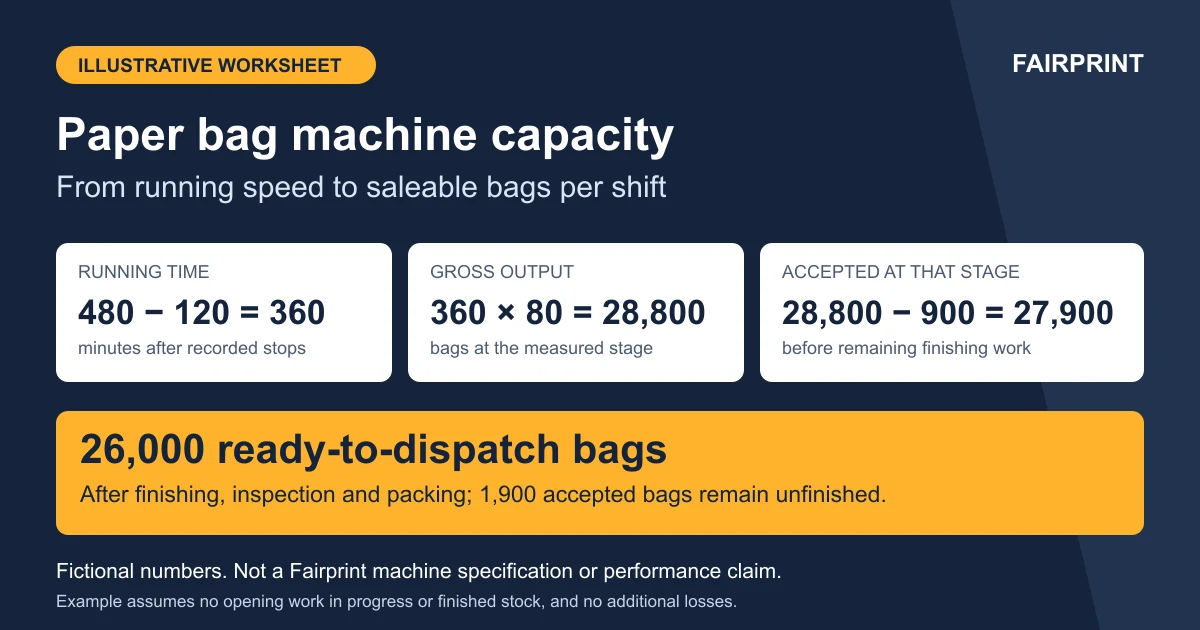
Suppose a scheduled eight-hour shift contains 480 minutes. Recorded non-overlapping stops total 120 minutes: 60 for setup and changeovers, 30 for planned breaks when production stops, and 30 for other interruptions. Actual running time is therefore 360 minutes.
Assume the observed average running rate for that particular job is 80 bags per minute. Gross output from the measured stage is 360 × 80 = 28,800 bags. If 900 pieces fail the agreed acceptance checks and none is successfully reworked within the period, acceptable output from that stage is 27,900 bags.
Now suppose that, by the end of the same shift, the remaining finishing, inspection and packing operations have completed 26,000 acceptable bags from this job. With no opening work in progress or finished stock and no additional losses, the shift has produced 26,000 ready-to-dispatch bags. The other 1,900 accepted bags from the earlier stage remain work in progress.
This example shows why the full workflow belongs in the capacity discussion.
6. Check printing, handles and packing capacity
Map the steps from incoming paper to packed bags. Ask which operations are included in the proposed equipment and which require another machine, another pass or manual handling. Check whether material must wait between stages and how that affects completion time.
Bag making and printing are different tasks, even where a particular configuration combines them. Confirm the proposed sequence for your artwork and bag design. Do not assume that a printing attachment, handle system or finishing unit is included because it appears in a demonstration photograph.
Where the proposed configuration supports it, a camera inspection system may help detect specified visible defects. Confirm what it checks, how defects are handled and which manual or functional checks remain necessary.
Compare the output of connected stages over the same time period. If one stage produces faster than the next can process, additional unfinished stock may accumulate. Plan space and handling for that stock instead of assuming the fastest stage determines dispatch capacity.
7. Test the order mix, not just one easy job
Prepare two or three representative orders for discussion with the supplier. Include your regular bag and a job that requires a meaningful change, such as a different size or artwork. Record changeover time and the acceptable output achieved for each.
Ask how material variation and operator experience may affect the result. Keep trial samples and the agreed operating conditions with your records. Where different suppliers are being compared, use comparable jobs and counting methods.
Capacity planning should also allow for normal variation between days. Build any scheduling allowance from recorded experience and the supplier’s guidance, rather than an unsupported universal percentage. Follow approved safety procedures throughout; a production target is never a reason to bypass guards or required maintenance.
8. Turn the results into a useful enquiry
When requesting a quotation, provide your finished-bag samples, material details, order quantities, typical batch sizes, available shift time and any existing printing or finishing equipment. Explain whether your target refers to formed bags or fully finished, packed bags.
Ask for the proposed configuration, included and optional equipment, installation requirements, operator training and written scope of support. Request a trial plan that records the conditions, counts and acceptance criteria needed for your capacity worksheet.
You can explore Fairprint’s paper bag making machine range and share your requirements through Fairprint’s contact page to discuss a model-specific quotation and demonstration.
The aim is a production plan you can explain and verify: what bag is being made, which operations are included, how much time is available and how many acceptable finished bags the complete process delivers.


